Search for a private jet charter and you will keep seeing numbers like "from $6,500/hour." The number is real, but it is only one line of a longer invoice. Between the advertised hourly rate and the amount you actually pay sit positioning flights, airport charges, federal taxes, and trip minimums that can move the total by thousands of dollars. We arrange private jet charters out of Fort Lauderdale, booking flights directly with aircraft owners, so we see every line of these quotes every day. Here is what each line means, which figures are fixed by law, and where booking direct from the owner changes the math.
What the Hourly Rate Actually Covers
The hourly rate is the price of the aircraft and its crew, and with most operators it also covers fuel. What it does not cover is everything the trip adds around the flying: the airports, the taxes, and the crew's time away from base.
The rate itself is set mainly by aircraft size. At our Fort Lauderdale operation, fleet cards run from $6,500/hour for a midsize Hawker 800XP that seats up to 8, through $7,500/hour for the super-midsize Falcon 50 and $9,500/hour for the heavy Falcon 900B, up to $11,000/hour for a Gulfstream IV-SP. We publish the numbers plainly, which is rarer than it should be: most charter websites show no prices at all. When you compare providers, a quoted rate without the aircraft category next to it tells you almost nothing.
The Lines Around the Rate
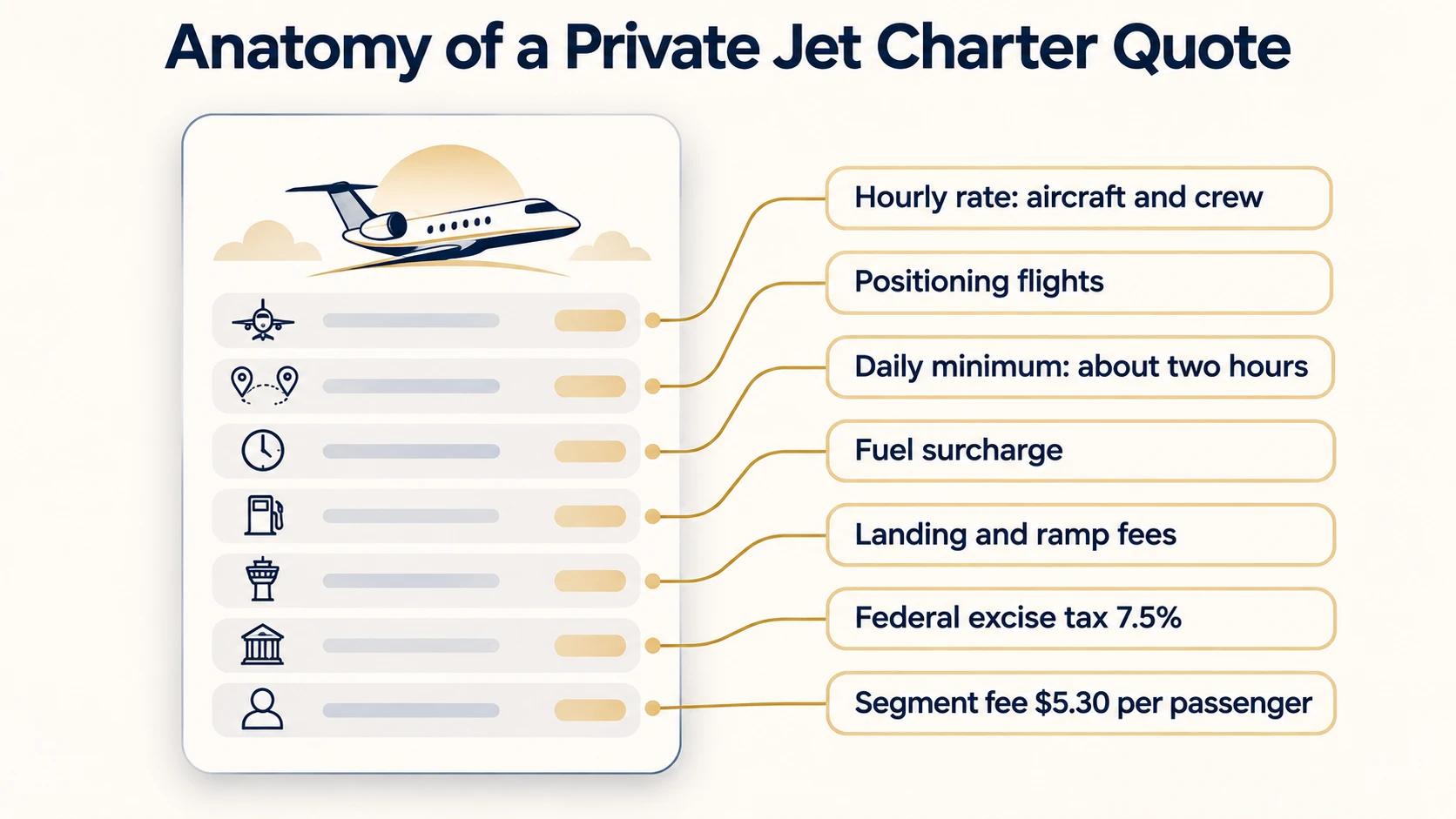
Four line items explain most of the gap between an hourly rate and a final invoice.
Positioning flights. The aircraft has to fly empty to reach your departure airport, and home again after it drops you. Those hours are usually billed like the trip itself. If a jet is already based where you are, the line is zero, which is why the same trip can price very differently depending on which aircraft you ask about. This is often the single biggest swing on a quote.
Trip minimums. Operators bill a minimum number of hours for each day you hold the aircraft, commonly around two hours a day for light and midsize jets, more for heavy jets. A 40-minute hop to the Bahamas on a day rate can therefore be priced as a multi-hour day.
Fuel surcharges. Some operators build fuel into the hourly rate, others list a surcharge separately and adjust it with jet fuel prices. Two quotes with identical hourly rates can differ by hundreds of dollars per hour once you know where the fuel money lives.
Airport charges and crew expenses. Every landing fee and ramp fee is set by the airport and usually scaled by aircraft weight, small at a quiet regional field and larger at the major business aviation hubs. Multi-day itineraries add crew hotels and per diems.
The Taxes the Government Sets
Unlike the line items above, the federal taxes on a US charter are not negotiable and not invented by your provider. A domestic charter carries a 7.5% federal excise tax on the amount paid, plus a segment tax of $5.30 per passenger for each leg flown in 2026, a leg being one takeoff and one landing. International trips pay a facilities tax of $23.40 per person instead of the excise tax, and flights arriving from abroad add customs, immigration, and agriculture fees of a few dollars per passenger at each US entry. The operator collects these and they appear as lines on the quote. The IRS adjusts the dollar figures every year, so an article quoting 2024 numbers is already out of date.
Where Booking Direct From the Owner Changes the Math
Most charter requests travel through a chain: an inquiry site sells the lead, a broker marks it up, and the operator that actually flies the flight sees only part of what you pay. Every link in that chain adds cost or friction.
Booking direct from the owner shortens the chain. You deal with the party that actually controls the aircraft, its crew, and its schedule, and the price conversation happens once instead of being relayed through intermediaries. Charter rates booked direct from owners are built on exactly that transparency: no layers of referral markup standing between you and the hourly rate. To be clear about our own role, we are not aircraft owners ourselves; we book flights direct from owners, and every flight is operated by a properly licensed direct air carrier.
Two questions expose the structure of any quote instantly: who operates the flight, and is the number in front of you the all-in total or a base rate with the rest to follow?
The Empty-Leg Shortcut
One more line of pricing deserves its own mention. When a booked one-way flight leaves an aircraft stranded away from its base, operators sell the return leg as an empty leg at a steep discount. On published empty-leg flights from Fort Lauderdale, savings of 25 to 75 percent are typical. The tradeoff is flexibility: an empty leg exists because of someone else's itinerary, so dates and times move with it. For travelers who can move too, it is the cheapest seat in private aviation.
A Five-Point Checklist Before You Sign
- Ask for the all-in total. A professional quote shows one number that includes flying time, positioning, fees, and taxes, and lists what it excludes.
- Look for the positioning hours. They should be visible as a line, not folded invisibly into the rate.
- Check the daily minimum. It prices your shortest days, so it matters more than the hourly rate on short hops.
- Ask which fees are estimates. Landing fees and customs charges are often estimated; the quote should say so.
- Confirm the exact aircraft in writing. Tail number if possible, not just a category, so the aircraft you inspected is the one that shows up.
The hourly rate is where the conversation starts, not where it ends. A clean quote is one where every line has a reason, and a provider who cannot explain a line has answered your real question.