Your English can be strong on paper and still stumble at the school gate, at the pharmacy counter, or at a parish coffee hour. Anyone who has moved to Miami from another country knows the gap between textbook English and conversation English: the words are there, but they arrive a beat too late, and the accent you never notice in your own head suddenly fills the room.
That gap is normal, and it closes the way every skill closes: with low-stakes practice, repeated often, before the conversations that matter. This article is about the missing step between studying English and living in it, and how a free anonymous chat that matches you with a random conversation partner can serve as your practice room.
Why Classroom English Doesn't Prepare You for Small Talk
Classes teach you the map: grammar, vocabulary, and model dialogues with predictable answers. Small talk is driving in live traffic: unexpected turns, interruptions, jokes that arrive before the punchline, and topics that change mid-sentence. A conversation partner does not wait while you translate your reply in your head.
Fluency is the ability to handle surprises, and handling surprises only develops inside real conversations. A weekly group class gives each shy student a few minutes of speaking time. A private tutor gives more, at a price per hour that adds up quickly. What most learners are missing is not knowledge but volume: hundreds of small, unimportant exchanges where a mistake costs nothing.
The Missing Step: Conversation That Doesn't Cost Anything
An effective bridge between study and real life has three properties: volume, variety, and low stakes. You need many conversations, with different people, in a setting where mistakes are cheap.
Anonymous text chat delivers all three. Nobody knows your name, your job, or your history, so there is no reputation to protect and no accent to be self-conscious about. If a chat stalls, it simply ends, and the next partner is one tap away. The price of a wrong word drops to zero, and with it most of the fear that freezes people in real conversations.
This is also why shy learners often progress faster by text than in person: the situation removes the audience, and the audience is what most people are actually afraid of.
What Practicing by Text Actually Builds
Room to think. In text, your partner waits while you compose the reply. You practice choosing words instead of panicking about speed, and the right words start arriving faster on their own.
Real phrasing. Real people write the way they talk: "how's it going", "no worries", "that makes sense", "long story short". These connective phrases barely appear in vocabulary lists, yet they are the mortar of everyday English.
The habit of asking. Conversations survive on questions, not statements. Random partners give you a fresh reason every few minutes to practice opening questions: what someone's day looks like, what they had for dinner, what weekends are like on the other side of the match.
Tolerance for endings. In a random chat, conversations end casually, without awkwardness. Getting comfortable with a conversation that simply finishes is a skill that carries directly into small talk.
From Typing to Talking: Voice Without a Camera
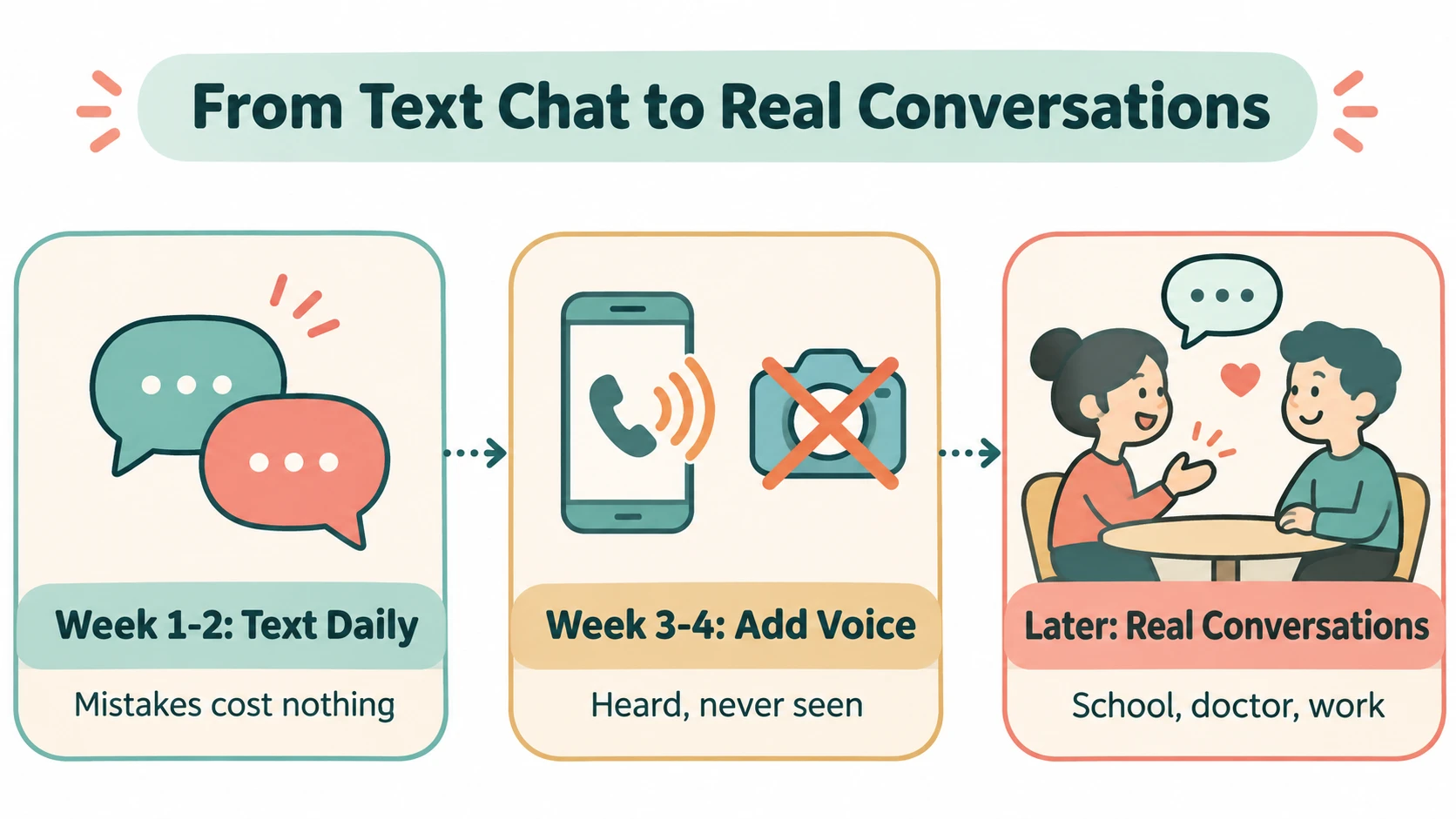
Text builds reflexes; speaking builds courage. The bridge between them is voice chat without video.
A voice conversation with a stranger keeps the anonymity but adds the pressure you eventually need: real-time listening, pronunciation, and the discipline of holding a spoken thread of thought. For people who dread phone calls, this is the gentlest possible middle step, because the difficulty rises while the stakes stay near zero.
Chatus was built around exactly this gradient: text and voice chat with no video at all. You are heard but never seen, which for many learners is the whole point. A few practice calls with strangers can make the school phone call, the doctor's appointment, or the parent-teacher meeting feel routine rather than dreaded. In our experience running the service, one spoken exchange a week is the pace at which learners first report that real calls feel different.
A Simple Weekly Routine
- Fifteen minutes a day beats two hours on Sunday. Frequency trains reflexes; marathons train fatigue.
- Open with a question, not a greeting. "What was the best part of your day?" starts more conversations than "hi".
- Keep a phrase notebook. Write down three phrases per session that surprised you. Reviewing them is your personal, updated textbook.
- Rotate partners. Different people, different rhythms, different topics. Variety is the training effect.
- Add one voice conversation a week. The pace matters more than the length: a single spoken exchange weekly is enough to feel the difference within a month.
Practice Etiquette and Safety
A few rules keep practice useful and safe for everyone. The service is for adults only, and conversations are moderated, but the basics are yours to own: never share your address, workplace, documents, or financial details with a stranger, in any chat. Be civil the way you would be civil in person; anonymity is no excuse for rudeness. If a conversation turns uncomfortable, end it and move to the next one. Politeness that survives anonymity is precisely the social skill that later makes small talk effortless.
The Practice Room, Not the Destination
Nothing replaces the parish community, the language class, or the friendships that grow across a real table. Anonymous chat is not a destination; it is a training room: a place to make a hundred cheap mistakes in peace, so that the conversations which matter cost you nothing to enjoy.
If your English is ready on paper but not yet in person, start small: a short text conversation today, a voice one next week. Chatus runs inside Telegram with no app installation and no registration, so the first practice session is about ninety seconds away.